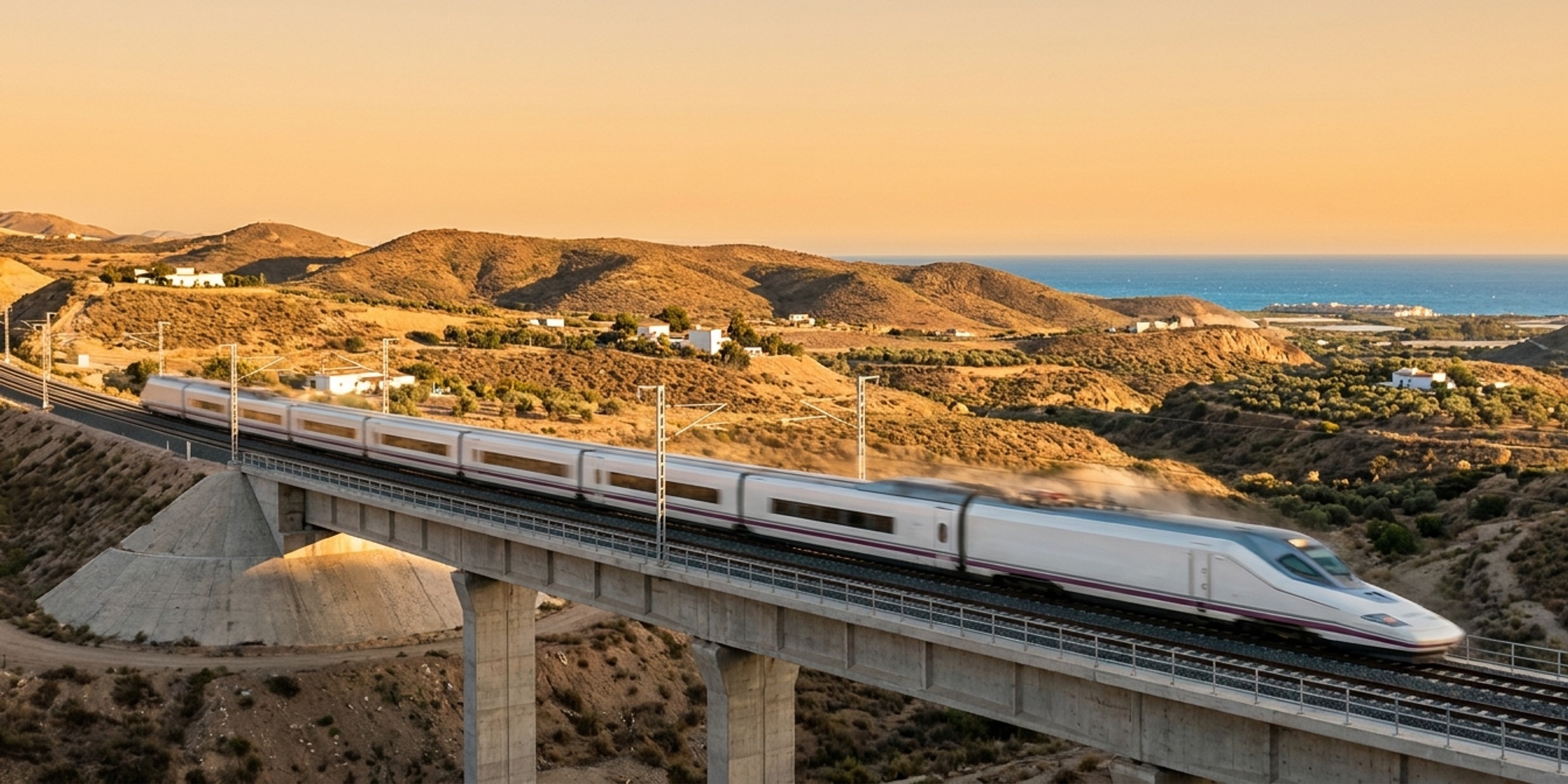

Spain is closing the last gap in its Mediterranean rail corridor. The new high-speed line between Murcia and Almería is under construction along the entire route, and when it opens, the small coastal town of Vera will have something its better-known neighbours do not: a true AVE station. For anyone considering a property on the Costa de Almería, this is the infrastructure story worth understanding properly.
In this article we set out the facts: what is being built, how far the works have progressed, what role the Vera-Almanzora station will play, and what this does (and does not) mean for property buyers in Vera, Vera Playa, Mojácar and Garrucha.
The Murcia–Almería line in brief
The new line (LAV Murcia–Almería) is 198 kilometres long, of which 90 kilometres run through the province of Murcia and 108 through Almería. It is designed for speeds of up to 300 km/h, is fully electrified, uses the European ERTMS level 2 signalling system and has no level crossings. The total investment is around 3.5 billion euros.
The line is the last missing link of the Mediterranean Corridor. Today there is no direct rail connection between Murcia and Almería at all: passengers and freight travelling between Almería and the rest of the Levante coast must detour via Madrid. Once the line opens, Almería will be connected to Spain's high-speed network for the first time.
How far along is construction?
As of the summer of 2026, the platform (earthworks, viaducts and tunnels) is complete or under construction along the entire route, and track laying has been awarded or tendered in all three sections. On the Murcia–Lorca section the platform is largely finished, around 1,600 catenary masts have been erected and the traction substation at Totana is structurally complete. The final construction phase was authorised by the Spanish council of ministers in April 2026.
There is no official opening date. Independent technical analyses point to around 2029, with the Lorca–Pulpí section seen as the critical path. We deliberately do not repeat the earlier dates that circulate online: the current state of the works does not support them.
An AVE station at Vera-Almanzora
Vera-Almanzora is one of only four full AVE stations on the corridor. The station is being built just south of the town of Vera and will serve the long-distance services between Murcia and Almería. Neighbouring Pulpí and Puerto Lumbreras will get stations too, but for regional Cercanías services, not AVE.
That makes Vera-Almanzora the rail gateway for the whole surrounding coast: Vera Playa, Mojácar, Garrucha and Los Gallardos will all rely on this station. In an area where property markets are largely defined by driving distance to an airport, a high-speed station a few minutes' drive away is a genuinely scarce asset.
Travel times that change the map
Once services run, Almería city will be roughly 30 to 40 minutes from Vera-Almanzora, and Murcia just over an hour. In Murcia, the line connects to the completely rebuilt Murcia del Carmen station, where AVE services to Madrid have been running since late 2022. The new alignment enters the city through a 6.6-kilometre rail corridor that is currently in its finishing phase.
For owners who let their property, and for second-home owners who want flexibility, this widens the catchment area considerably: guests and visitors will be able to reach the Vera coast by rail from Madrid with a single change in Murcia.
What about the airports?
Be careful with claims about airport rail links. Murcia's Corvera airport (RMU) will not get a train station: no such project exists in the Spanish Ministry of Transport's planning studies. Corvera remains a roughly 25-minute drive or bus ride from Murcia city.
Alicante airport is a different story: a new station at the terminal (the Torrellano variant, phase I) received its environmental approval in June 2026, but the construction project is still being drafted and there is no official timetable. Realistically it opens in the early 2030s at the earliest, and it will be a Cercanías commuter station, not AVE.
What this means for property buyers
We will be straight with you: nobody can guarantee that the train will push prices up, and you should be sceptical of anyone who sells it that way. What the line verifiably changes is accessibility.
The relevant fact today is the entry price. Vera and its surroundings trade at a clearly lower price per square metre than Costa Blanca South, an hour up the coast. Buyers there pay for mature infrastructure; buyers in Vera currently do not, because the market has not priced in an infrastructure premium that does not exist yet. Buying here means buying the current market, with the AVE station as a documented, government-funded improvement being built a few kilometres away.
Spainora follows the projects around Vera closely. Browse our overview of Vera and the new developments in the area, or contact us for the current picture of prices and availability.