Table of Contents

While the Costa Cálida is famous for its golden beaches and golf resorts, the true soul of the Region of Murcia lies inland. For many international buyers, particularly from the Netherlands and the UK, the dream of Spanish property ownership isn't a modern apartment overlooking the sea, but a rustic 'finca' surrounded by almond groves, olive trees, and silence. However, buying rural property (suelo rústico) is significantly more complex than buying urban real estate.
The allure is undeniable: more space, lower price tags per square meter, and a connection to nature that is hard to find elsewhere in Europe. Yet, the path to owning a country house in Murcia requires specific knowledge regarding land classification, water rights, and town planning regulations. This guide provides the essential framework for navigating the rural market with confidence.
What Defines a 'Finca' in Murcia?
The term 'finca' is often used loosely by foreigners to describe any country house, but in Spanish legal terms, it simply refers to a plot of land. When browsing listings, you will generally encounter three categories:
- Finca Rústica (Rustic Land): Land designated for agriculture, livestock, or forestry. Building on this land is heavily restricted unless the plot size meets a minimum threshold (often 20,000m² in Murcia, though this varies by municipality).
- Casa de Campo (Country House): An existing detached house situated on rustic land. These are the most sought-after properties for renovation projects.
- Finca Urbana: A property that, while perhaps looking rural, falls within a town plan's urban zone, meaning it has full access to mains services and standard building permissions.

Prime Locations for Rural Living
Murcia is geographically diverse, offering everything from lush river valleys to high-altitude vineyards. Here are the primary areas for finca hunting:
The Ricote Valley
Often called the 'Spanish Shangri-La', this area follows the Segura River. It is lush, green, and dramatically beautiful with its Moorish history. Towns like Blanca, Ricote, and Ulea offer fincas nestled against steep cliffs, surrounded by lemon and orange groves. The plots here tend to be smaller due to the topography, but the views are unrivalled.
The Northwest (Comarca del Noroeste)
Including Caravaca de la Cruz, Cehegín, and Moratalla, this region is higher in altitude, offering cooler summers and occasional winter snow. The landscape is dominated by pine forests and mountains. Here, you can find substantial stone cortijos (farmhouses) with large tracts of land, ideal for those seeking total privacy.
Lorca and Totana
Located in the Guadalentín Valley, this area is drier and flatter, known for intense agriculture. Properties here often come with very large plots of land. The proximity to the Sierra Espuña natural park makes it popular for hikers and cyclists.
Yecla and Jumilla
The wine country of the north. The landscape here is vast, open, and arid, characterized by endless vineyards. If you dream of owning a hobby vineyard or an olive grove, this is the region to explore. Prices here can be exceptionally competitive compared to the coast.
The Legal Minefield: Checks and Balances
The most critical aspect of buying rural property in Murcia is ensuring legality. In the past, many country houses were built or extended without proper permits. When buying, your lawyer must verify the following:
1. The Nota Simple
Does the description in the Land Registry match physical reality? If the registry says there is a 50m² ruin but there is actually a 150m² villa with a pool, you have a legal discrepancy that must be resolved before purchase. The discrepancy often requires a 'New Work Declaration' (Declaración de Obra Nueva) to be signed retrospectively.
2. Urban Infractions
Your lawyer must request a certificate from the Town Hall (Certificado de No Infracción Urbanística) to ensure there are no open disciplinary files against the property. If there is an outstanding demolition order, you could inherit it.
3. AFO (Asimilado a Fuera de Ordenación)
In Murcia, like in Andalusia, properties built without a license that can no longer be legally demolished (due to the statute of limitations) can often obtain an AFO certificate. This document recognizes the building's existence and allows for utility connections, but strictly limits future expansion. It confirms the house is 'tolerated' but technically 'out of order'.
Water and Electricity in the Campo
Unlike urban apartments, utilities are not a given in rural Murcia. Understanding the difference between potable water and agricultural water is vital.
- Mains Water (Agua Potable): Many remote fincas are not connected to the municipal drinking water network. Check the distance to the nearest connection point.
- Agricultural Water (Agua de Riego): This is cheaper water intended for farming, delivered via a network of canals or pipes. It is not fit for human consumption without filtration systems. Buying a finca often involves buying 'acciones' (shares) in the local water community.
- Electricity: If the grid is too far away, solar energy is a highly viable option in Murcia, which enjoys over 300 days of sunshine a year. Modern solar systems with lithium batteries can run a luxury home comfortably.

Renovation: Dream vs. Reality
Buying a ruin to restore is a romantic notion, but financial prudence is required. In 'Rustic Land', you are generally allowed to maintain and restore existing buildings, but extending the footprint is often prohibited or requires a very large plot size (e.g., 20,000m²).
Always obtain a written report from a local architect regarding what is permissible on the specific plot before putting down a deposit. Do not rely on verbal assurances that 'you can build whatever you want because nobody checks.' The authorities in Murcia now use drones and satellite imagery to monitor illegal rural construction.
Conclusion: Is a Finca Right for You?
Buying a finca in Murcia offers a lifestyle of tranquility, connection to the land, and exceptional value for money compared to the coastal belt. Whether it is a restored farmhouse in the Ricote Valley or a new build on a large plot in Lorca, the options are diverse.
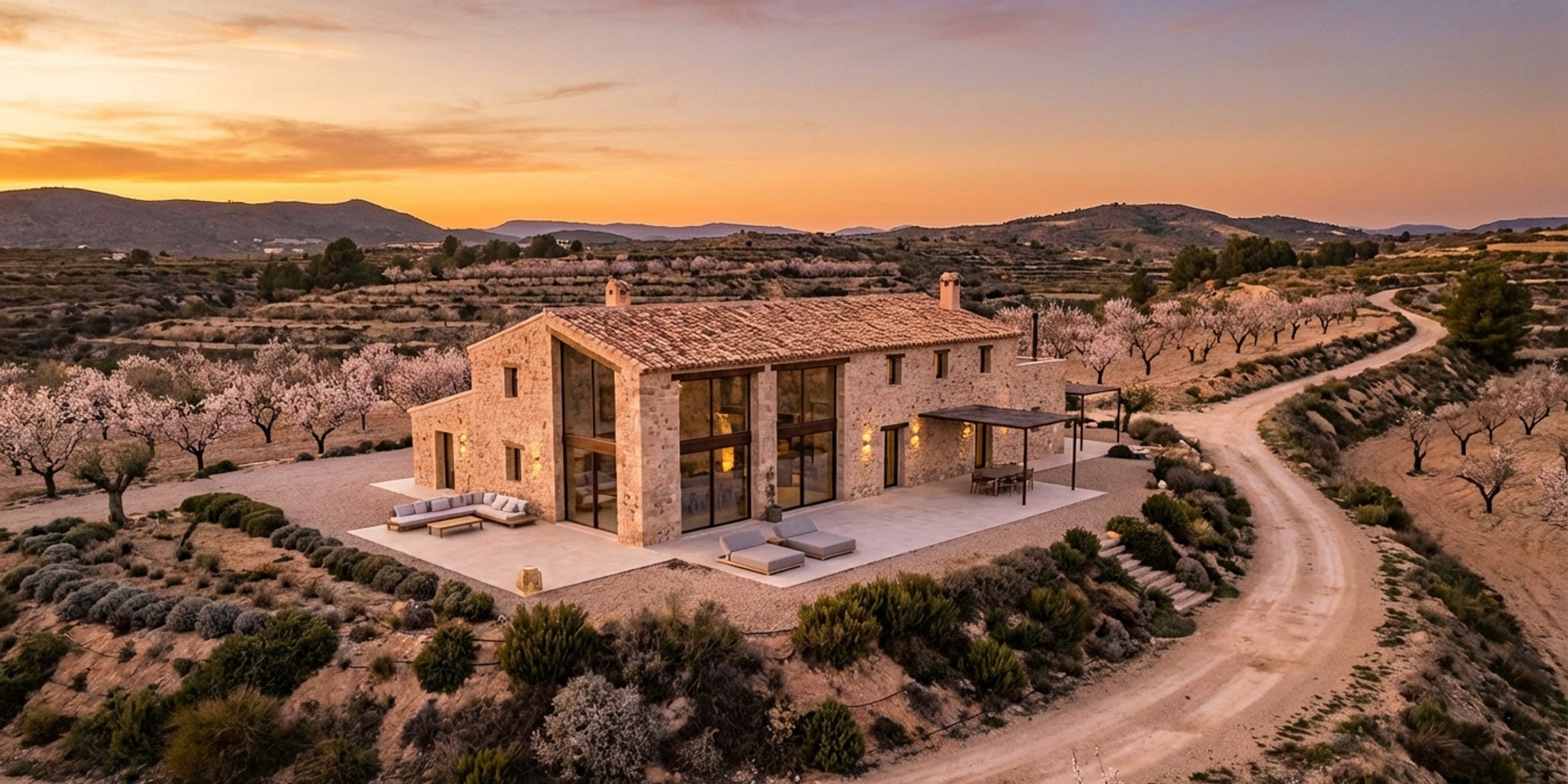
However, due diligence is non-negotiable. The complexity of rural laws means you must work with a specialized agent and an independent lawyer who understands rural conveyancing. With the right team, your dream of a life under the Spanish sun, surrounded by almond blossoms and mountains, can become a secure and beautiful reality.