Table of Contents

Purchasing a home in Spain is a profound milestone for many international buyers, offering the promise of a vibrant Mediterranean lifestyle. However, securing your dream property requires more than just agreeing on a purchase price; it requires a meticulous approach to financial planning and a thorough understanding of closing costs. When budgeting for your Spanish real estate acquisition, one of the most essential expenditures to account for is the notary fee.
In Spain, the Notary (or 'Notario') plays an indispensable role in the property transfer process. Their involvement is a strict legal requirement for registering the property in your name at the Land Registry. Understanding how notary fees are calculated, who is responsible for paying them, and how they fit into the broader spectrum of property purchasing costs will empower you to navigate the Spanish real estate market with confidence and financial clarity.
The Essential Role of the Spanish Notary
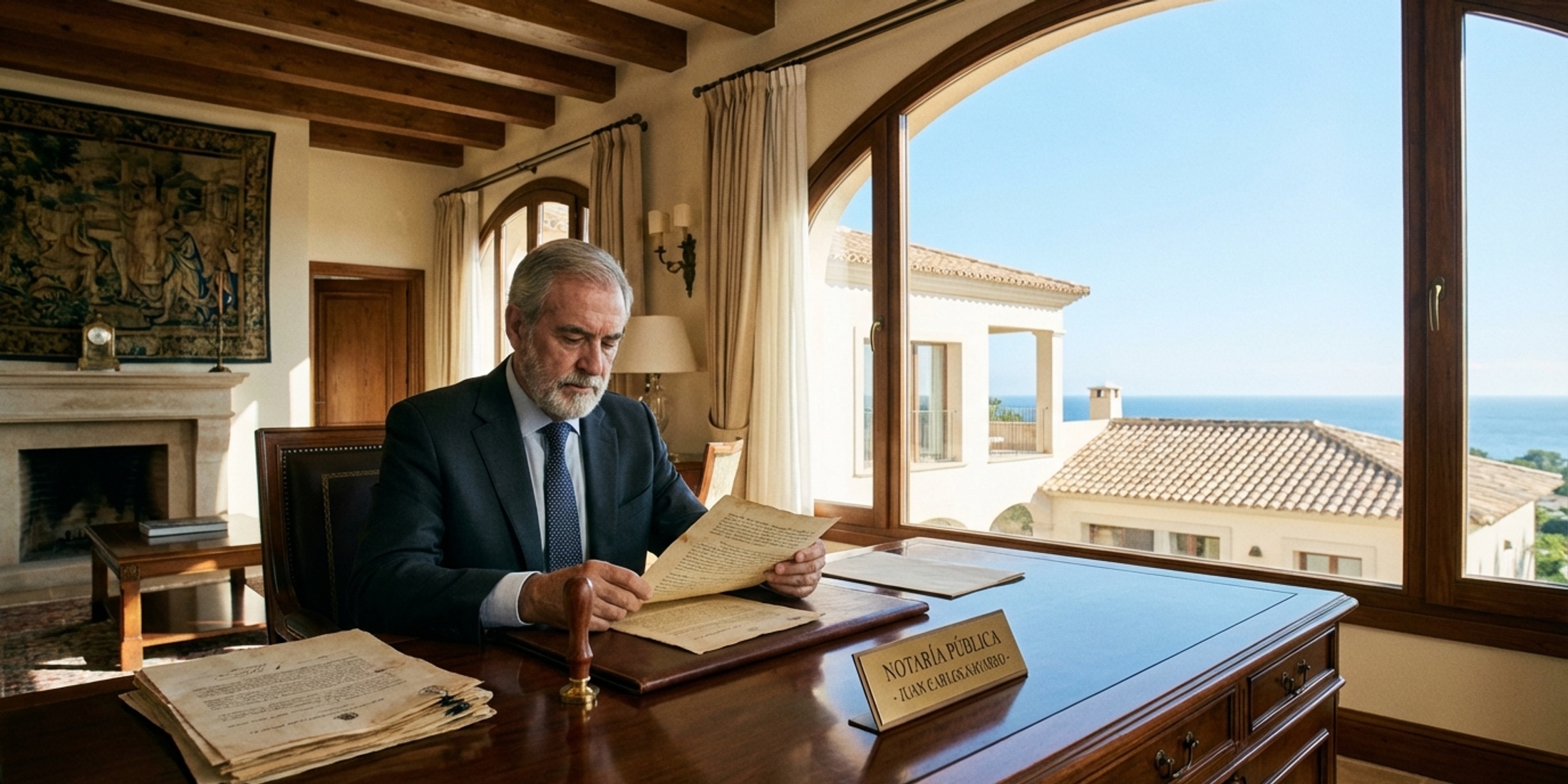
To the uninitiated, the role of the Notary in Spain can sometimes be misunderstood. A Spanish Notario is a highly qualified legal professional and a public official appointed by the state. Unlike a private solicitor who advocates for your specific interests, the Notary acts as an impartial witness representing the Spanish government. Their primary mandate is to ensure that the transaction adheres strictly to Spanish law and that all documentation is legally sound.
During a real estate transaction, the Notary is responsible for several critical tasks:
- Confirming the identities, marital statuses, and legal capacities of all parties involved in the transaction.
- Verifying the property's title deeds and checking the Land Registry (Registro de la Propiedad) to ensure there are no hidden debts, embargoes, or encumbrances on the property.
- Ensuring that the buyer has transferred the funds correctly and transparently, complying with strict anti-money laundering regulations.
- Drafting and witnessing the signature of the Title Deed, known as the 'Escritura Pública de Compraventa'.
How Notary Fees Are Calculated in Spain
Notary fees in Spain are not arbitrary, nor are they subject to negotiation. They are strictly regulated by the government through a fixed scale known as the 'arancel notarial'. This means that all notaries in Spain charge exactly the same base fee for identical services. However, the final invoice can vary slightly from one transaction to another due to the specific variables of the sale.
Key Variables Influencing the Cost
- The declared purchase price: This is the most significant factor. The higher the value of the property, the higher the base notary fee.
- The length of the deed: Notaries charge per page for the documentation. If your transaction requires extensive annexes or complex clauses, the fee will marginally increase.
- The number of parties involved: If there are multiple buyers, sellers, or guarantors, additional identity verifications are required, slightly raising the cost.
- Number of certified copies: You will pay for every authorized physical copy of the title deed that is requested.
The Official Fee Scale (Aranceles)
The official tariff scale applies a descending percentage to different brackets of the property's price. For example, the percentage applied to the first €60,000 is higher than the percentage applied to amounts between €100,000 and €500,000. While the exact figure can only be determined by the Notary at the time of drafting the deed, buyers can generally expect the base fee to hover between €400 and €1,000 for standard residential properties.

Estimating Your Notary Costs: Practical Examples
As a general rule of thumb, notary fees for a property purchase in Spain range between 0.1% and 0.5% of the declared property value. For lower-priced properties, the percentage leans closer to the 0.5% mark due to minimum baseline charges, while luxury properties will see the percentage drop closer to 0.1%.
For instance, if you are purchasing a holiday apartment in the Costa Blanca for €150,000, you can estimate your notary fees to be approximately €600 to €800. If you are investing in a luxury villa in Marbella for €1,500,000, the notary fees might range from €1,000 to €1,500. Remember, these are estimates, and the final invoice will factor in the length of the deed and administrative extras.
The Impact of Mortgages (The 2019 Law Update)
If you are financing your purchase with a Spanish mortgage, you are effectively signing two separate deeds at the notary's office: one for the property purchase and one for the mortgage loan. Historically, the buyer was responsible for both sets of notary fees. However, following a significant legal reform in 2019 (Ley de Contratos de Crédito Inmobiliario), Spanish banks are now legally obligated to cover the notary fees, land registry fees, and gestoría fees associated with the mortgage deed. The buyer is now only responsible for the notary fee associated with the property purchase deed and the property valuation fee.
Who Pays the Notary Fees in Spain?
Under Article 1455 of the Spanish Civil Code, the division of notary expenses is defined by law unless agreed otherwise. By default, the seller is supposed to pay for the 'matrix' (the original deed), and the buyer pays for the first authorized copy. In practice, this roughly equates to an 80/20 split, with the seller carrying the heavier burden.
However, it is overwhelmingly customary in the Spanish real estate market to include a clause in the reservation contract and private purchase contract stipulating that the buyer pays 100% of the notary fees. This is entirely legal under the 'freedom of contract' principle, provided both parties agree. As an international buyer, you should almost always budget to pay the entirety of the notary fees for the purchase deed, as this is the standard market expectation.
The Difference Between a Notary and a Lawyer
A common misconception among international buyers is that hiring a Notary replaces the need for a private lawyer (abogado). This is a dangerous oversight. While the Notary ensures the transaction is legal at the exact moment of signing, they do not conduct deep, preliminary due diligence on your behalf. They will not verify if the property has illegal extensions, check for missing municipal licenses, or review the fine print of your preliminary reservation contracts.
An independent Spanish property lawyer works exclusively for you. They will perform comprehensive checks in the weeks leading up to the notary appointment to ensure you are buying a safe asset. Budgeting 1% of the purchase price for excellent independent legal representation is just as crucial as paying your notary fees.
Related Post-Notary Expenses
The Notary fee is just one piece of the closing cost puzzle. Immediately following the signing of the deeds, a sequence of administrative steps must be taken to formalize your ownership, all of which incur fees:
- Land Registry Fees (Registro de la Propiedad): Once the Notary authorizes the deed, it must be inscribed in the Land Registry. These fees are also calculated on a sliding scale based on property value, generally amounting to roughly 50% to 70% of the notary fee.
- Gestoría Fees: A 'Gestoría' is an administrative agency that handles the physical legwork of presenting the deeds to the tax office, paying the relevant taxes on your behalf, and taking the paperwork to the Land Registry. Their fee is usually a flat rate between €300 and €600.
- Taxes (ITP or IVA): This is the largest closing cost. Depending on whether you are buying a resale property (requiring Property Transfer Tax ranging from 6% to 11% depending on the region) or a new build (requiring 10% VAT plus Stamp Duty), you must ensure you have liquid funds available immediately after the notary signing.

Professional Tips for Managing Real Estate Costs
To ensure a stress-free completion, international buyers should ideally budget an additional 10% to 13% of the property's purchase price to cover all associated taxes and fees, including the notary. A highly recommended practice is to request a 'Provision of Funds' (Provisión de Fondos) breakdown from your lawyer or gestoría before the signing date. This document will outline exact estimates for the notary, land registry, gestoría, and taxes, allowing you to transfer the exact amount required well in advance.
Conclusion
While notary fees are an unavoidable expense when buying property in Spain, they provide an invaluable service: unparalleled legal certainty. The Notary guarantees that the transaction is official, recognized by the state, and that you are the rightful owner. By understanding how the 'aranceles' are calculated and factoring them into your initial budget, you eliminate closing-day surprises. Armed with this knowledge, you are one step closer to confidently signing on the dotted line and beginning your new life in Spain.