Table of Contents

For decades, international buyers in southeastern Spain have followed a predictable trajectory: fly into Alicante, drive south, and purchase near the beaches of the Mar Menor or Orihuela Costa. While the allure of the coast is undeniable, a significant shift is occurring in the regional property market. Murcia City, the seventh-largest city in Spain, is stepping out of the shadows to offer a distinct, high-value proposition for the discerning investor.
With a population exceeding 460,000, Murcia is a bustling administrative and university hub that operates year-round, unencumbered by the seasonality of coastal resorts. For Dutch and British investors seeking authentic Spanish culture combined with robust asset appreciation potential, the capital represents a strategic entry point.
The Economic Value Proposition
The primary driver for investment in Murcia City is the price disparity compared to neighboring provincial capitals. While Valencia and Málaga have seen property prices skyrocket due to saturation and tourism pressure, Murcia remains undervalued relative to its infrastructure and quality of life.
Current market data suggests that prime real estate in Murcia's city centre can be acquired for significantly less per square metre than comparable properties in Alicante. This lower entry point allows for higher potential capital appreciation as the city continues its modernization trajectory. For investors, this means the ability to acquire larger, higher-spec apartments in premium postcodes—assets that tend to hold their value robustly during market fluctuations.

Infrastructure: The Connectivity Game Changer
Real estate values are inextricably linked to connectivity. Murcia has recently benefited from two major infrastructure milestones that have transformed its accessibility:
- High-Speed Rail (AVE): The arrival of the AVE train connects Murcia to Madrid in approximately 2 hours and 45 minutes. This link has opened the city to the capital's business sector and weekend tourism, increasing demand for short-term luxury rentals near the station.
- Corvera International Airport (RMU): Located just 20 minutes from the city centre, the region's dedicated airport continues to expand its route map, facilitating easier access for Northern European owners.
District Analysis: Where to Invest
Murcia is a city of distinct neighbourhoods, each offering different yield profiles and lifestyle benefits. Understanding these micro-markets is essential for a successful acquisition.
1. The Historic Centre (La Catedral / Santa Eulalia)
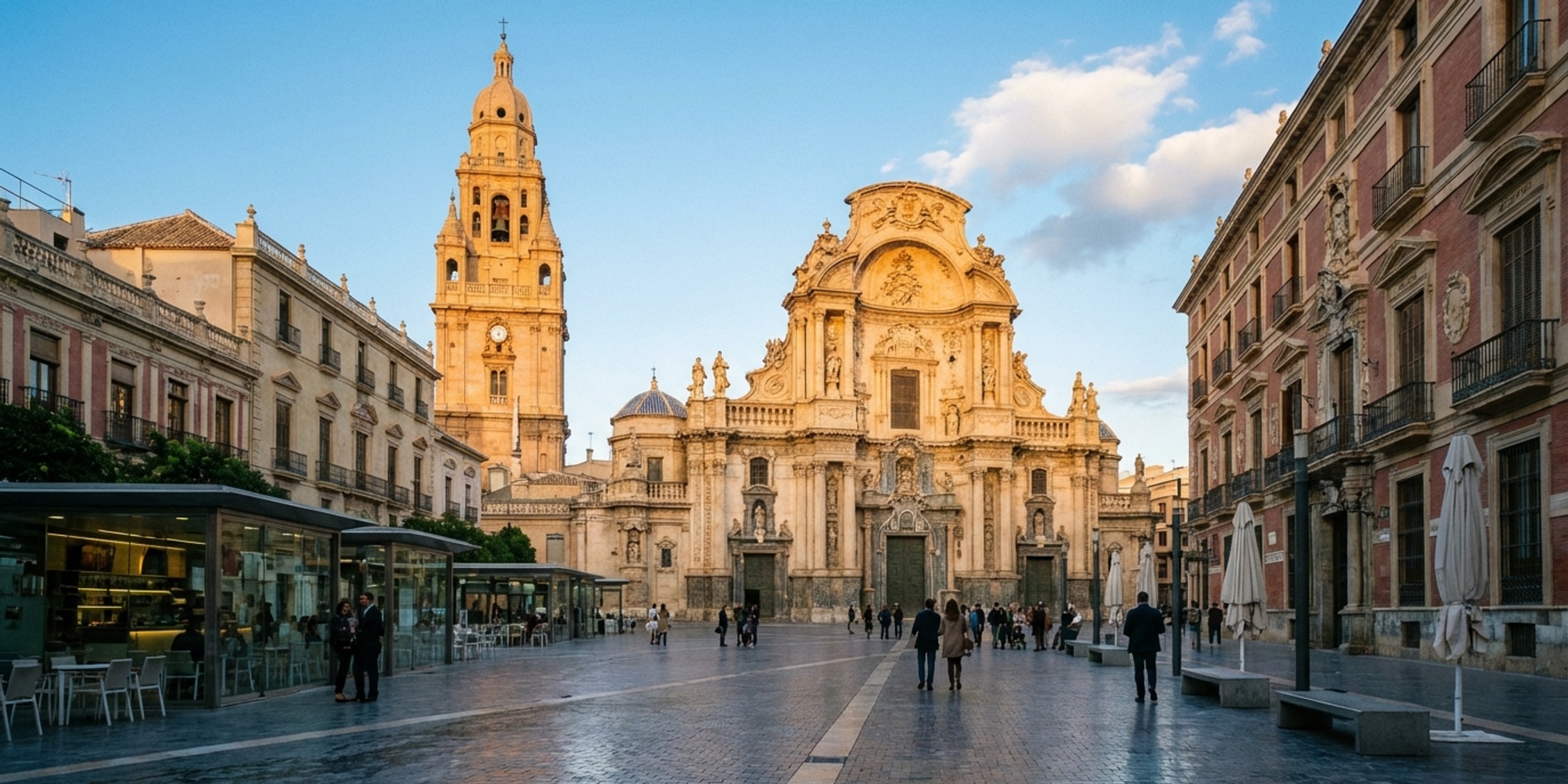
This is the premium choice for investors seeking heritage assets. The pedestrianised streets around Trapería and Platería, leading to the magnificent Cathedral, command the highest prices. Properties here are often in historic buildings requiring renovation, but the rental demand—both long-term and high-end tourist—is perennial. The nearby Santa Eulalia neighbourhood offers a bohemian, artistic vibe with vibrant plazas.
2. Juan Carlos I and The North
For those preferring modern construction, the northern expansion along Avenida Juan Carlos I is the prime target. This area features wide boulevards, the tram line (connecting to universities and shopping centres), and contemporary residential complexes with pools and parking. This is a favorite for upper-middle-class Spanish families and expatriates seeking modern conveniences.
3. El Carmen
Historically a working-class district south of the river, El Carmen is currently undergoing rapid gentrification due to the arrival of the AVE station. It represents an excellent opportunity for investors looking for growth potential (capital gains) rather than immediate high yields, as the area regenerates around the new transport hub.
The Rental Market: Students and Professionals
One of Murcia's strongest assets is its educational sector. The city is home to the University of Murcia and UCAM (Catholic University), drawing thousands of national and international students annually. This creates a robust buy-to-let market.
- Student Rentals: Apartments near the tram line (La Flota, Espinardo, Juan Carlos I) offer consistent yields during the academic year.
- Digital Nomads: Murcia is increasingly attractive to remote workers who appreciate the low cost of living, high-speed fiber internet, and warm climate without the distractions of a pure holiday resort.

Lifestyle: The 'Huerta' and Gastronomy
Investing in Murcia is also an investment in a specific quality of life. Known as the 'Orchard of Europe' (La Huerta), the city is surrounded by fertile agricultural land, which directly influences its gastronomy. Murcia was named Spain's Capital of Gastronomy in recent years, a title that boosted its international profile.
Life here revolves around the outdoors. The Plaza de las Flores is the epicenter of social life, where tapas culture is a daily ritual rather than a tourist attraction. For the international buyer, the city offers a safe, walkable, and culturally rich environment that feels authentically Spanish, distinct from the expatriate bubbles found on the coast.
Conclusion: The Window of Opportunity
Murcia City is at a pivotal moment. The infrastructure is in place, the quality of life is high, and the university sector provides a stable economic floor. However, property prices have not yet fully corrected to reflect these advantages compared to other major Spanish capitals.
For the investor willing to look beyond the beach, Murcia offers a mature market with genuine growth prospects. Whether seeking a heritage apartment in the baroque centre or a modern unit in the expanding north, the capital presents a compelling case for 2025: urban sophistication at a price point that the coast simply cannot match.